Every eVTOL commercialization deck assumes the vertiports will be ready.
Meanwhile, infrastructure operators are being asked to commit capital before the aircraft are certified, before local operating rules are settled, and before repeat passenger demand has been demonstrated.
That may be the sector's hardest unit-economics problem. A small group of operators is answering it with meaningfully different bets.
WHO'S BUILDING WHAT
Skyports Infrastructure: global developer-operator
UK-based Skyports develops and operates both heliports and vertiports. Its current portfolio includes Downtown Skyport in New York, Skyports London Heliport, Bicester Skyport, Cergy-Pontoise in France, the Dubai vertiport network, and Joby's California Living Lab. ACS is now its largest investor; Groupe ADP remains a shareholder and development partner. Skyports also has a long-running partnership with Wisk to evaluate an autonomous-air-taxi network in southeast Queensland.
The bet: build an aircraft-agnostic operating platform across existing heliports, airport-adjacent facilities, and selected new sites, then reuse the operating, regulatory, and technology stack across markets.
VertiPorts by Atlantic: the FBO-network overlay
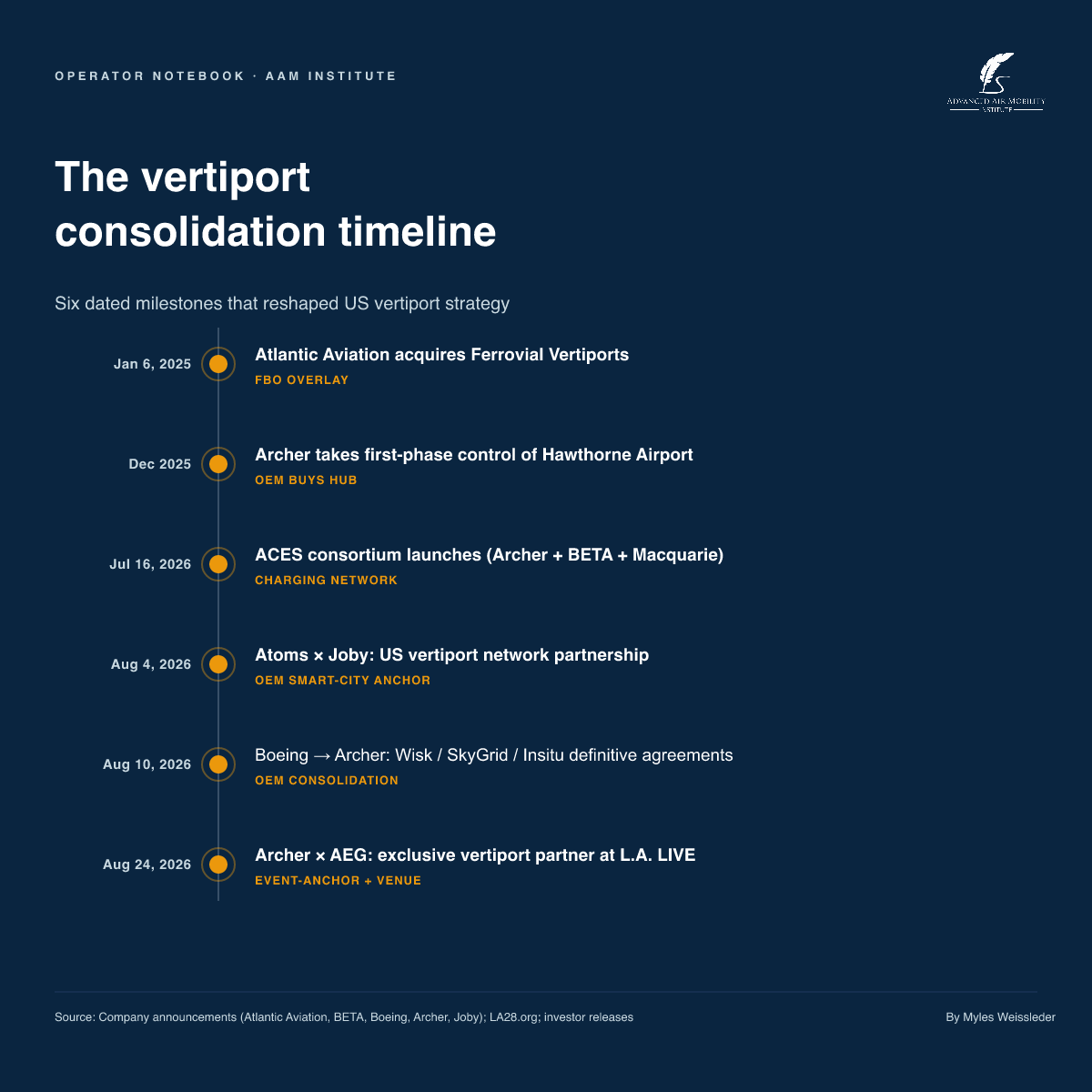
Atlantic Aviation acquired Ferrovial Vertiports on January 6, 2025, renamed the business VertiPorts by Atlantic, and folded its development expertise into Atlantic's U.S. fixed-base-operator network. The business is led by Kevin Cox, whose aviation career includes senior roles at DFW International Airport, American Airlines, Signature Aviation, Ferrovial, and EPIC Fuels.
VertiPorts by Atlantic operates Manhattan's East 34th Street Heliport. In April 2026, Joby's New York flight campaign used that site along with Downtown Skyport and the West 30th Street Heliport. The campaign began April 27; Joby's subsequent SEC filing describes the flights as an April, week-long campaign.
The bet: add charging and powered-lift capability to aviation real estate that already has traffic, staff, ground services, and a regulatory history. Less a greenfield real-estate thesis than an extension of the FBO model.
UrbanV: airport-backed regional networks
UrbanV began as a venture involving Aeroporti di Roma, SAVE, Aeroporto di Bologna, and Aéroports de la Côte d'Azur. Aeroporti di Roma increased its ownership to 81.29% in 2025. UrbanV's active network plans include Rome, Venice, and the Côte d'Azur, where existing airport and helicopter infrastructure can be adapted over time. Its Rome-Fiumicino sandbox also supported Italy's first SAIL III operational authorization for the DLV-2 drone in March 2026.
The bet: use airport shareholders, existing aviation assets, and regional tourism demand to build corridors gradually rather than starting with a stand-alone urban network.
Atoms and Joby: purpose-built multimodal hubs
On August 4, 2026, Atoms and Joby announced a strategic partnership to acquire and develop U.S. vertiport sites. The initial focus is Florida, New York, and Texas, the markets tied to Joby's eVTOL Integration Pilot Program (eIPP) activity, plus California. The companies describe the proposed sites as multimodal hubs combining electric aircraft, autonomous ground vehicles, ridesharing, and on-site power. These are announced plans, not operating infrastructure.
The bet: develop a new class of transportation hub with an aircraft company as the anchor partner and ground mobility designed into the site from the beginning.
Four approaches. One shared question: how do you finance a network before certified aircraft and repeat passenger demand arrive?
ALSO WORTH WATCHING
Skyportz: distributed landing surfaces
Australia's Skyportz (distinct from UK-based Skyports Infrastructure) is developing Aeroberm, a modular vertipad system intended for existing properties and new sites. The work received A$250,000 through the Australian Government's Industry Growth Program. Skyportz says it has assembled a portfolio of potential Australian sites, subject to regulatory approval. That is not the same as 400 committed or approved vertiports.
The bet: distribute standardized landing surfaces across existing properties instead of concentrating activity in a small number of expensive hubs.
One correction worth flagging: the publicly documented Wisk infrastructure partnership is with Skyports Infrastructure, not Skyportz.
Gilmore Group: modular, experience-led infrastructure
New York-based Gilmore Group presents a prefabricated, aircraft-agnostic "kit of parts" spanning mobile vertistops, vertiports, vertibases, and larger vertihubs. Its proposition combines aviation planning with human factors, passenger experience, and brand design. Its public materials support modular waterfront applications, but the stronger claim of active Manhattan floating-barge projects is not publicly verifiable.
The bet: lower deployment risk through modularity and make passenger experience part of the infrastructure product rather than an afterthought.
Landings: rural network through property partnerships
Landings says it is building a rural network of landing and charging sites and markets a property-owner model that includes revenue sharing, charging fees, and site services. It describes an initial network ambition of more than 2,000 locations from Canada to the Caribbean. Those are company plans, not evidence of an operating network today, so they should be treated as early-stage claims.
The bet: use landowner economics to build distributed access around medical, educational, and regional-mobility use cases rather than premium urban air taxis.
Archer, AEG, and Hawthorne: the event-anchor model
Archer was selected as the Official Air Taxi Provider of LA28 and Team USA in 2025. On August 24, 2026, Archer and AEG announced a multi-year collaboration to develop a vertiport at L.A. LIVE, making Archer the district's exclusive air-taxi partner. The site has completed an initial feasibility study; it is not yet an operating vertiport. Archer's planned Los Angeles network also includes SoFi Stadium, USC, and Hollywood Burbank, with Hawthorne Airport as the planned operating hub. Archer acquired control of Hawthorne's real-estate and master-lease position in December 2025 through the first phase of a multi-phase transaction.
The L.A. LIVE plan calls for BETA chargers through ACES, the July 2026 consortium formed by Archer, BETA Technologies, and Macquarie Capital to pursue interoperable charging at up to 250 U.S. sites by 2030. That is a stated target, not deployed infrastructure.
The bet: combine a fixed-date global event, a downtown venue partner, and control of an existing airport. If it works, Los Angeles becomes an unusually visible test of OEM-led network economics. If it slips, the delay will be just as visible.
THE PRE-REVENUE MATH
A greenfield vertiport can require land, environmental and airspace review, structural work, utility upgrades, charging, fire protection, security, passenger facilities, and ground operations.
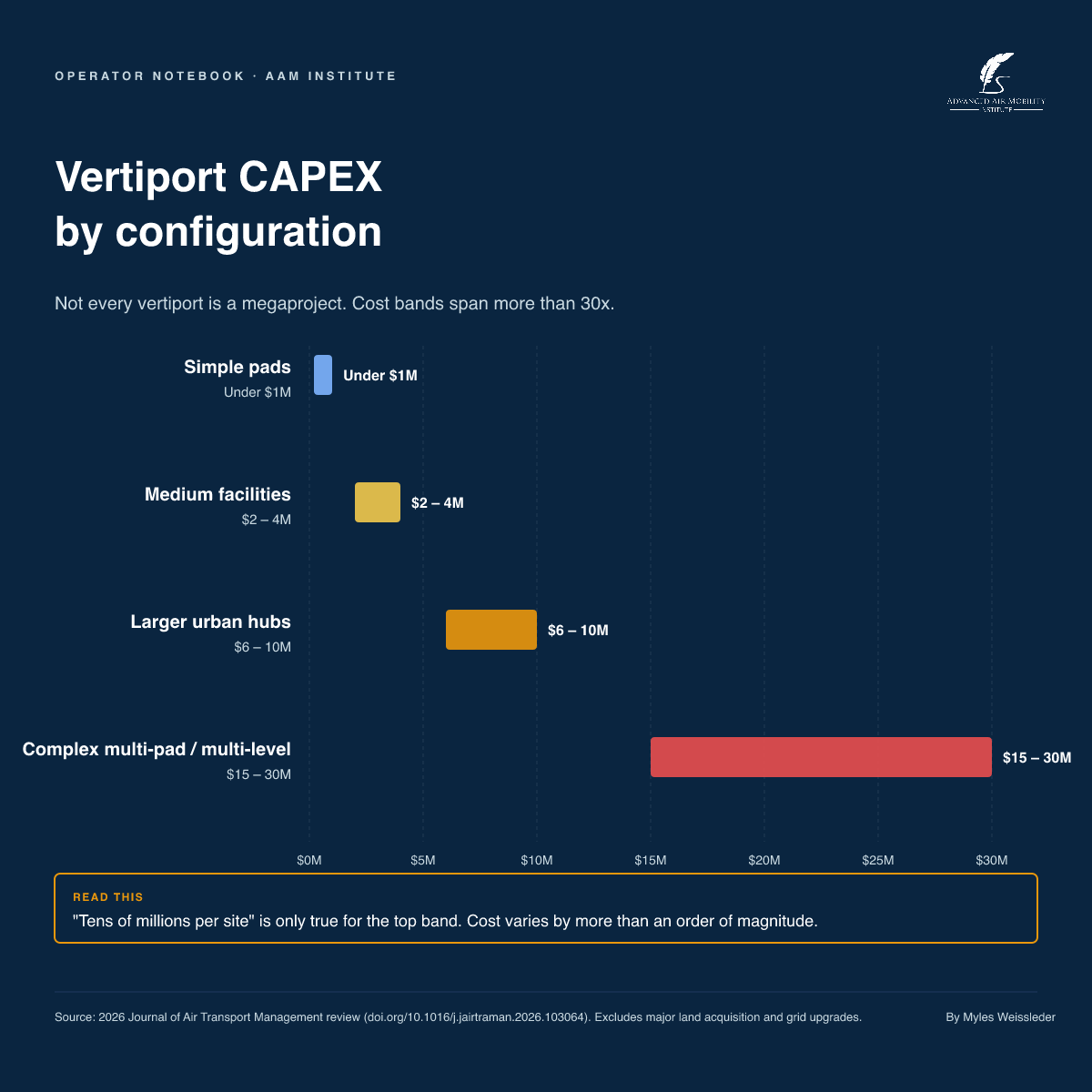
"Tens of millions per site" is too broad. Published estimates vary by configuration: simple pads can be below $1 million; medium facilities are often modeled around $2 to 4 million; larger urban hubs around $6 to 10 million; and complex multi-pad or multi-level hubs can reach roughly $15 to 30 million, often before unusually expensive land or grid work. The useful point is not that every vertiport is a megaproject. It is that cost varies by more than an order of magnitude, and the highest-cost sites need a credible bridge to demand.
The timing claim needs similar care. The FAA says initial AAM operations will use modified airports and heliports as well as new facilities. In 2026, eIPP demonstrations and early operations are beginning before full type certification, while scaled passenger service remains dependent on certification, operating approvals, infrastructure, and fleet production. A blanket "three-to-five-year wait" may be directionally plausible for some greenfield projects, but it is not a verified sector-wide rule.
WHAT MIGHT GENERATE REVENUE IN THE MEANTIME
The bridge-revenue thesis is strongest where the site already supports aviation or another established use:
• Helicopter operations. Dual-use is possible when aircraft dimensions, weight, and facility standards align. The FAA notes vertiports may accommodate helicopters that fit the controlling dimensions and maximum takeoff weight of the design aircraft. • FBO and airport services. Fueling, handling, hangars, and maintenance can support existing traffic, but only at airport or heliport sites equipped and authorized for those services. • Drone logistics. BVLOS cargo or medical operations could create demand at some sites, but this depends on airspace, operating authority, location, and customer contracts. It is an option, not automatic bridge revenue. • Retail, parking, and ground transportation. These can contribute at high-traffic mixed-use sites, though the business case belongs to the underlying real estate more than to eVTOL operations.
The strongest commercial cases are likely to stack existing revenue with future powered-lift demand. The important distinction is between revenue already visible at a site and revenue that exists only in a deck.
THREE STRATEGIC SPLITS
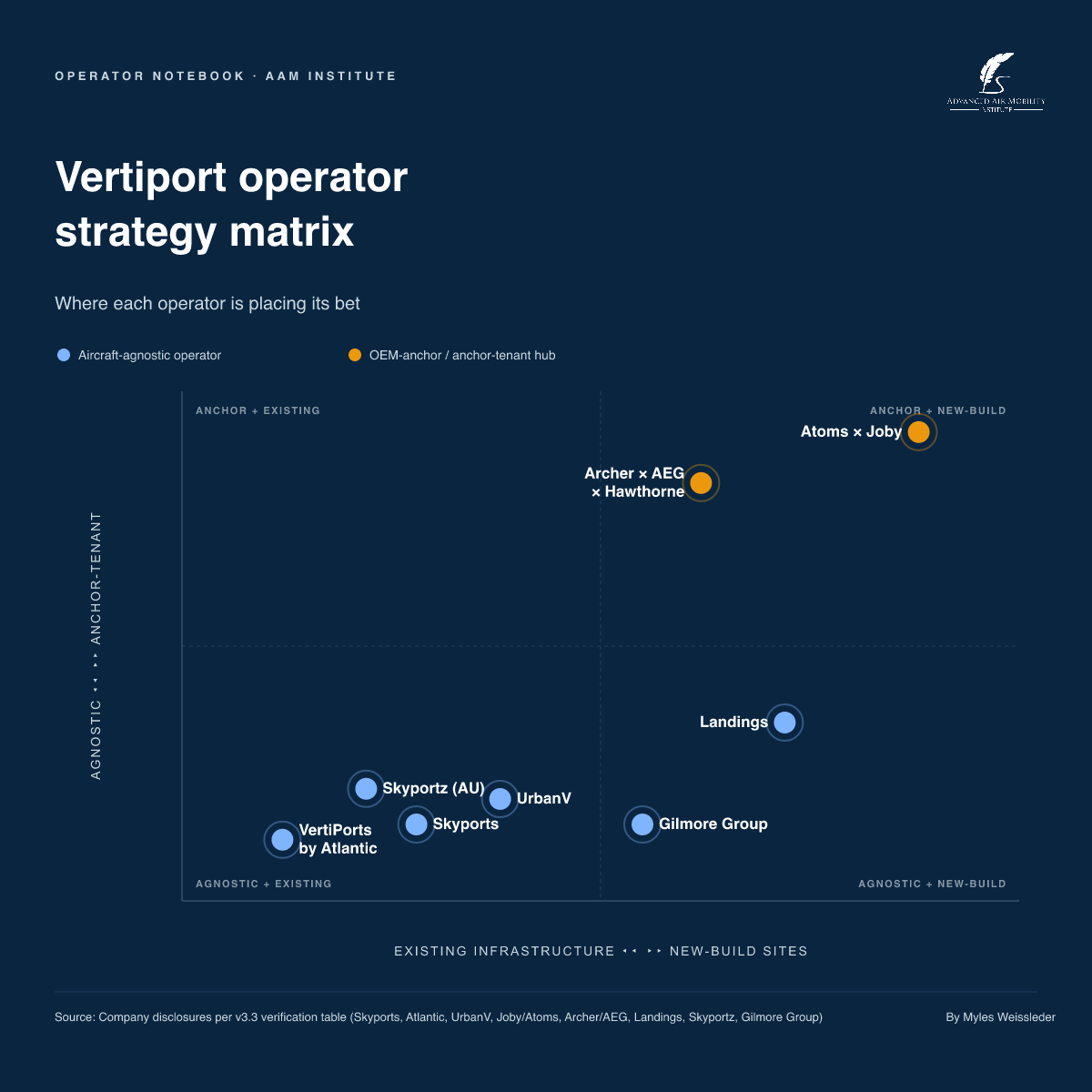
Existing aviation infrastructure vs. new urban hubs. Skyports and VertiPorts by Atlantic can adapt existing heliports and airport assets, inheriting some operating infrastructure and aviation context. UrbanV sits between those models through airport-backed regional networks. Atoms is pursuing purpose-built multimodal sites. The trade-off is straightforward: existing sites may lower execution risk but sacrifice some destination value; new urban hubs can improve passenger convenience but carry more entitlement, power, and construction risk.
Agnostic infrastructure vs. anchor-tenant networks. Skyports, VertiPorts by Atlantic, and UrbanV present largely aircraft-agnostic infrastructure strategies. Atoms and Joby are building around a named aircraft partner. Archer is running the same anchor strategy from the OEM side in Los Angeles, combining LA28, AEG, and Hawthorne. An anchor can de-risk initial demand and design decisions. It can also concentrate exposure to one manufacturer's certification, fleet, and operating timeline.
Urban clusters vs. distributed regional access. Much of the sector is still organized around metro corridors and airport transfers. Landings is making the opposite claim: that rural and regional access can support a distributed property-partnership model. Skyportz sits between those poles by trying to make smaller installations feasible across varied existing properties.
None of these models has won. They are competing answers to the same question: does long-term vertiport value accrue to scarce location, existing aviation operations, network scale, standardization, an anchor tenant, or the surrounding real-estate business?
AUGUST 2026: THE UPSTREAM SHIFT
On August 10, 2026, Archer and Boeing announced definitive agreements under which Archer would acquire Boeing subsidiaries Wisk Aero, SkyGrid, and Insitu. Boeing said it would take an undisclosed stake in Archer and enter a technology-sharing relationship; the companies expect the transaction to close by the end of 2026, subject to conditions.
The move matters upstream of every infrastructure strategy in this piece. It would combine an air-taxi OEM with autonomous-aircraft development, airspace-management software, and an established military UAS business. Anchor-tenant strategies now sit against a more consolidated OEM landscape, while aircraft-agnostic operators must decide how much differentiation to build above the landing pad.
THE UNDERAPPRECIATED COMMERCIALIZATION STORY
Every eVTOL fleet needs somewhere to land, charge, turn passengers, and connect to the ground journey. Every infrastructure network needs a way to survive before aircraft utilization reaches scale.
The graveyard will probably include beautiful sites built too early, promising sites in the wrong places, and "agnostic" infrastructure that turned out not to be compatible with enough aircraft. It may also include vertically integrated networks that concentrated too much risk in one OEM.
That is why the vertiport operator, not just the aircraft, is worth watching. The companies working through these pre-fleet years will determine what vertiport unit economics actually means.