On March 9, 2026, the US Department of Transportation and the FAA announced eight selections for the Advanced Air Mobility and eVTOL Integration Pilot Program, or eIPP. More than 30 proposals were submitted. The selected projects span 26 states.
The program is, first and foremost, a safety-testing and regulatory-learning framework. It is designed to generate operational data that can inform future rules, standards, and community-integration practices.
It may also have a consequential second-order effect: giving participating regions an early advantage in operational experience, regulatory coordination, infrastructure planning, and public engagement.
That is not the same as deciding who will win commercial advanced air mobility. The selections are pilot projects, not commercial franchises, and participation does not guarantee certification, scaled service, or lasting market leadership. But early operating experience matters, and it will not be distributed evenly.
THE EIGHT PROJECTS
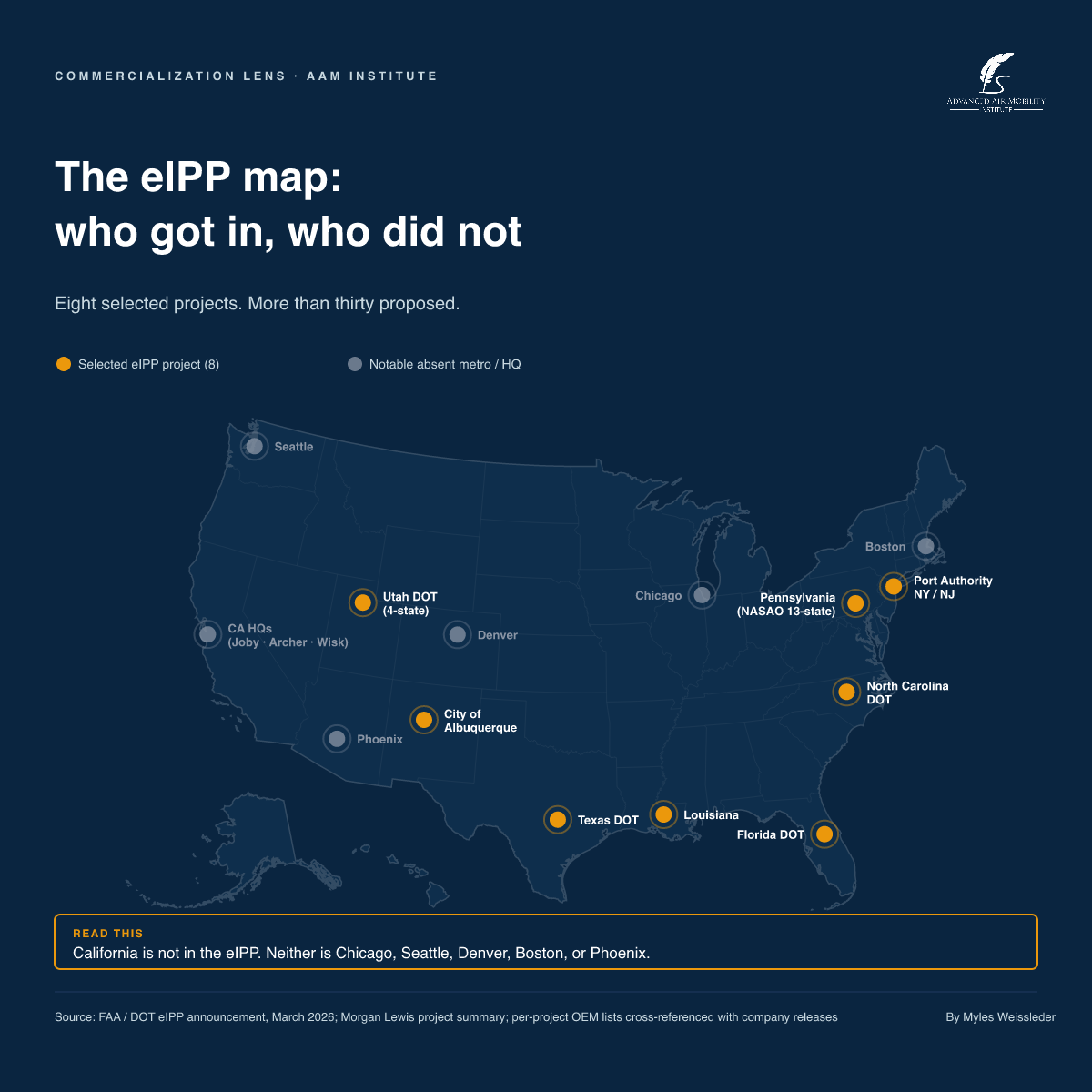
Port Authority of New York and New Jersey, Archer, BETA, Electra, Joby Twelve operational concepts across New England, including eVTOL passenger operations at the Manhattan heliport.
Texas Department of Transportation, Archer, BETA, Joby, Wisk Regional passenger flights connecting Dallas, Austin, San Antonio, and eventually Houston, with air-taxi networks extending from those cities.
Utah Department of Transportation, Ampaire, BETA, Joby, and other partners A four-state program spanning the Pacific Northwest, the Rocky Mountains, and the Plains of Oklahoma.
Pennsylvania Department of Transportation, BETA, Electra, and other partners A 13-state collaboration focused on revitalizing regional aviation, including routes resembling those supported by the Essential Air Service program.
Louisiana Department of Transportation and Development, BETA, Elroy Air, and other partners Cargo and personnel transportation serving offshore and energy-sector locations in Louisiana, Texas, Mississippi, and the Gulf.
Florida Department of Transportation, Archer, BETA, Electra, Joby, and other partners A statewide, three-phase effort covering cargo delivery, passenger transportation, automation, and medical response.
North Carolina Department of Transportation, BETA, Joby, and other partners Piloted medical and regional operations across North Carolina, plus an autonomous-flight operation extending into Virginia.
City of Albuquerque, Reliable Robotics A focused autonomous-flight project involving a developer already operating in the region and coordinating with the FAA.
These are eight projects, not eight discrete metros. Some have clear metropolitan anchors, but several cover entire states or multistate regions.
THE OEM HEATMAP
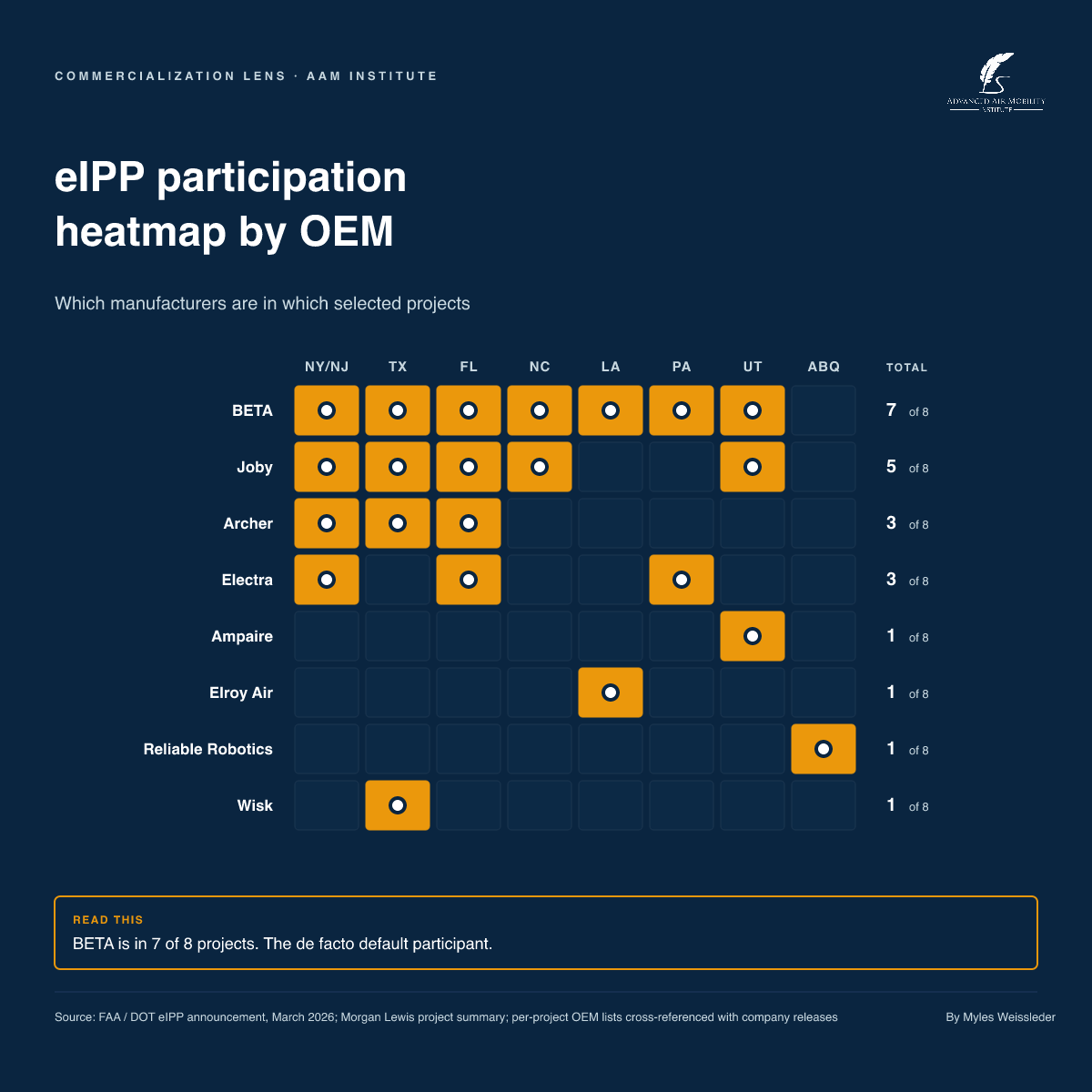
Among the partners publicly named by the FAA:
BETA appears in seven of the eight projects.
Joby appears in five.
Archer and Electra appear in three each.
Ampaire, Elroy Air, Wisk, and Reliable Robotics each appear in one.
BETA's reach is the clearest feature of the map. Its presence across passenger, cargo, medical, regional, and offshore concepts positions it to gather experience across an unusually broad range of operating environments.
The counts should not be treated as market-share forecasts. A company's role may range from aircraft supplier or technical partner to an active flight operator, and the FAA announcement does not specify the commercial scope of every partnership.
THE MOST VISIBLE EARLY MARKETS
Three selections stand out for their potential passenger-market visibility: New York, the Texas corridor, and Florida.
Each includes four named aircraft developers, although the participating companies are not identical. Each also overlaps with places where Joby says it is preparing early eIPP operations.
That makes these regions credible candidates for highly visible early demonstrations and limited operations. It does not make them guaranteed launch sites for every participating manufacturer, or establish that they will dominate the eventual commercial market.
The distinction matters. Pilot operations can establish routes, procedures, infrastructure requirements, and community relationships. Commercial service at scale still depends on aircraft certification, operating authority, approved test plans, infrastructure, financing, and local demand.
CALIFORNIA'S ABSENCE, AND CONTINUING ROLE
California is not the lead jurisdiction for any of the eight selected projects.
That is notable because Joby is based in Santa Cruz, Archer in San Jose, and Wisk in Mountain View. The state contains major engineering, manufacturing, certification, and flight-test activity for the sector.
But it would be premature to say California "lost." The FAA has not publicly identified every rejected applicant, so the announcement alone does not establish whether California or a Caltrans-led coalition submitted a proposal, or why any such proposal was not selected.
Nor does California's absence from the selected-project list remove it from the industry's development path. Joby, for example, is conducting certification-related flight testing with an FAA-conforming aircraft at its Marina, California, facility. Certification testing and eIPP operations are separate regulatory tracks.
Other major aviation centers, including Chicago, Boston, Phoenix, Denver, Seattle, and the Bay Area as a named urban-air-taxi market, also do not appear as lead locations. Some may nevertheless be touched by the program's multistate projects or pursue AAM development outside eIPP.
THE POTENTIAL COMPOUNDING ADVANTAGE
Participating jurisdictions may accumulate assets that later entrants will have to build:
operating data;
relationships with federal regulators;
experience approving routes and facilities;
community-engagement history;
noise and public-acceptance data;
trained personnel;
emergency-response procedures; and
supplier and infrastructure networks.
Those advantages could compound, especially where projects lead to durable infrastructure or repeat operations. But the size and persistence of the advantage remain uncertain. Other regions can develop infrastructure independently, learn from published program results, or enter the market after aircraft and regulatory requirements become more settled.
The likely outcome is not a permanent divide between eight winners and everyone else. It is a temporary, and potentially valuable, head start distributed across 26 states and several distinct use cases.
THE ATOMS–JOBY WRINKLE
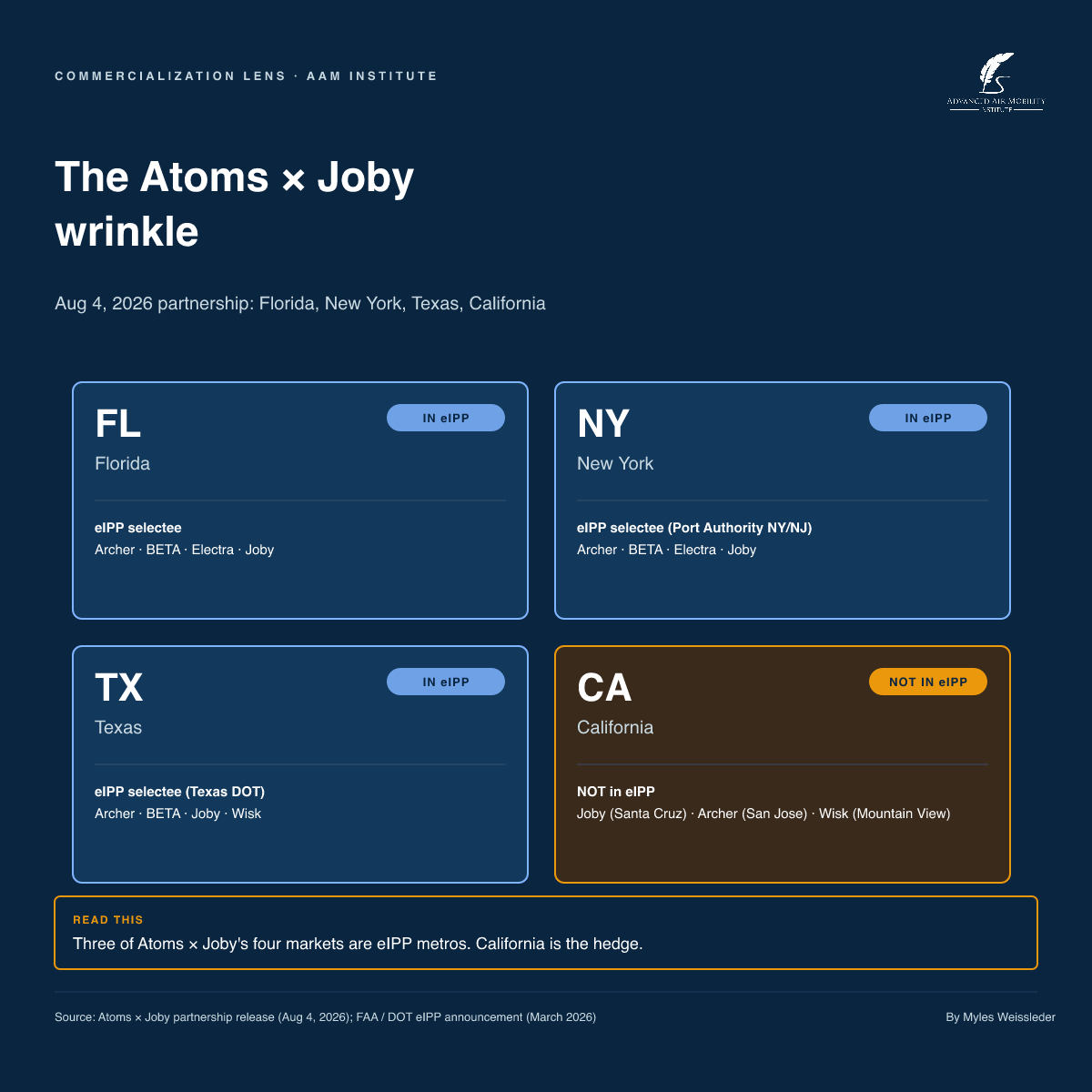
On August 4, 2026, Atoms and Joby announced a partnership to acquire and develop vertiport sites in Florida, New York, Texas, and California.
The first three overlap with markets where Joby says it is preparing early eIPP operations. California does not, making it an important parallel investment outside the selected-project map.
That decision suggests Joby does not view eIPP participation as the only path to developing a future market. It is pursuing infrastructure both where the pilot program may enable early operations and in California, where it already has a substantial corporate, testing, and certification presence.
The partnership is strategically significant, but its outcome remains prospective. The companies have announced an initial geographic focus, not completed vertiports or guaranteed commercial launch dates.
THE FRAMING TO ADOPT
The eIPP does not determine which cities or companies will win advanced air mobility.
It does determine where a substantial share of the country's earliest federally coordinated operational learning will occur.
That distinction offers a more useful way to read the map. The selected jurisdictions may gain experience, relationships, infrastructure knowledge, and public legitimacy before many of their peers. Those gains could influence where early services become viable and where capital flows next.
But eIPP remains a pilot program. Projects must still clear contractual, operational, safety, certification, infrastructure, and market hurdles. The selected regions have received an opportunity to move earlier, not an assurance that they will move successfully or remain ahead.
The commercial map of the late 2020s may therefore look different from today's map of technical talent and private capital. eIPP is one force shaping that transition, but it is not the only one.
Understanding that balance, the genuine value of an early lead without mistaking it for a predetermined victory, is the right way to read what happens next.