The civilian story still dominates advanced air mobility: passengers, airport transfers, regional connections, medical missions and new forms of personal flight. The financing story, meanwhile, is increasingly military. Across the sector, defense work has moved beyond a side program or a convenient source of non-dilutive research funding and become a bridge business, revenue, manufacturing learning, autonomy development, flight hours and customer validation that can accumulate while civilian certification takes longer.
The examples are stacking up quickly. Joby's agreement to acquire Resonant Sciences brings aerospace and defense engineering capability into a company still spending heavily on civilian aircraft certification and launch. Archer's pending Boeing transaction is a larger version of the same move: if completed, it brings Wisk, SkyGrid and Insitu under Archer, and Insitu is not an experimental side project but an established uncrewed-aircraft business with more than $200 million in annual revenue, according to the companies. BETA's MV250 extends its platform into hybrid-electric autonomous defense missions with Sikorsky MATRIX autonomy layered onto the program. Pivotal has pursued defense and public-safety applications for its light eVTOL platform, LIFT has worked with the U.S. Air Force, and other AAM companies are increasingly positioning autonomy, logistics, contested-environment mobility and dual-use manufacturing as core capabilities rather than optional adjacencies.
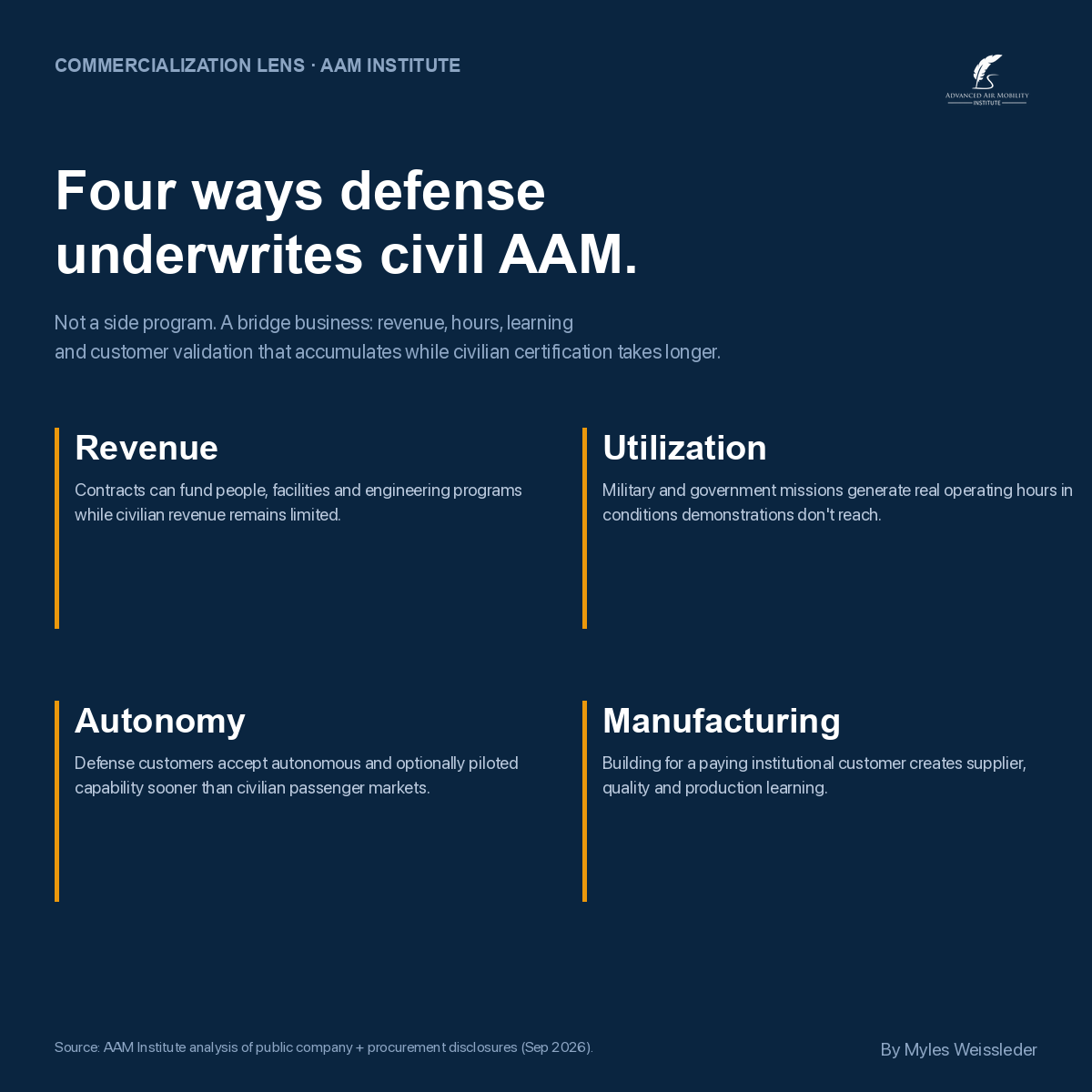
The reason for the shift is that the civilian clock and the capital clock do not move at the same speed. Type certification takes years, manufacturing takes capital before it produces scale economics, infrastructure often must be built before passenger revenue arrives, and public markets have become less forgiving of open-ended funding requirements. Defense work changes that equation in four related ways. It provides revenue, so a defense contract can support people, facilities and engineering programs while civilian revenue remains limited. It generates utilization, because military and government missions expose systems to operating hours and conditions that demonstrations do not. It accelerates autonomy, because defense customers often value autonomous and optionally piloted capability sooner than civilian passenger markets can accept it. And it produces manufacturing learning, because building hardware for a paying institutional customer creates supplier, quality and production experience that carries into commercial programs.
There is a real risk of reading too much into the pattern. A defense program does not automatically validate a civilian business model, mission requirements can diverge, procurement cycles can be slow, specialized military configurations can pull engineering resources away from the commercial product, and a company can become strategically broader without becoming operationally simpler. Even so, the direction is clear enough to matter. The sector is no longer divided neatly into "civilian eVTOL companies" and "defense aerospace companies," and the strongest capital bridges may belong to companies that can serve both. That changes how progress should be evaluated: civilian certification remains crucial, and it should be tracked alongside defense revenue, autonomous capability, dual-use manufacturing and the ability to keep learning while the passenger market matures. The civilian AAM race may still determine what the public ultimately sees, but defense will help decide which companies are still around when that market arrives.