Personal eVTOL has begun to produce something much of advanced air mobility still lacks: customers with aircraft in the field.
Pivotal announced thirteen completed BlackFly deliveries in October 2024. Owner John Chirtea has publicly placed the private-individual share at approximately five aircraft, consistent with the Los Angeles Times reporting of roughly six private early-access customers; other aircraft were supplied into institutional and defense programs, including the U.S. Air Force.
One of those private owners, Tim Lum, has logged 1,653 flights, 172 hours 46 minutes and 7,738 miles in his current flight record. His aircraft, TL39, has accumulated 1,992 flights. Lum also reports that BlackFly pilot Quinn Reece has completed more than 400 flights, including two live EMS responses. The figures are provided by Lum and have not been independently audited.
That last example matters beyond utilization. An owner accumulating hundreds or thousands of flights demonstrates repeat operation. An aircraft being put to use in live emergency-response situations begins to demonstrate something different: customers discovering operational applications beyond the original personal-flight proposition. That is an early form of market development. The manufacturer does not have to originate every use case; experienced operators can expose where the product creates value, which in turn can inform positioning, partnerships, training, support and future product requirements.
Jetson's official order page reports that its 2026 and 2027 production allocations are sold out and identifies individual aircraft chassis as delivered, with 2028 reservations open. LIFT has pursued a different commercialization model, offering operator-managed HEXA flight experiences while separately marketing aircraft to public agencies under a limited public-use allocation.
These programs operate under pathways and with customer expectations that differ substantially from certificated passenger air taxis.
Customer activity, however, is only one commercialization milestone.
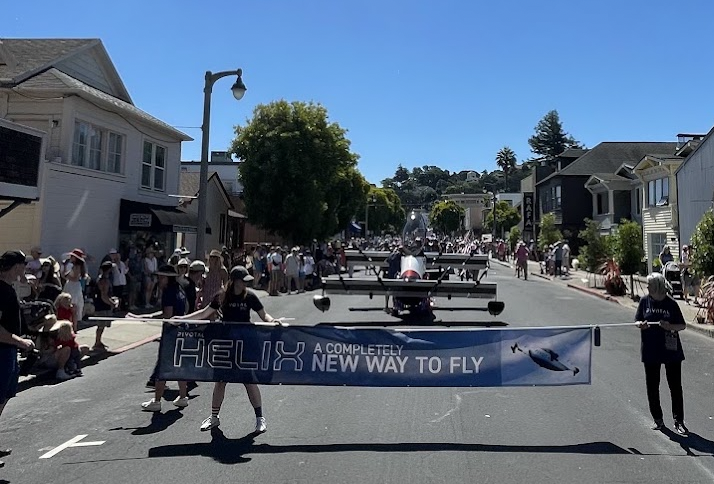
BlackFly provides useful evidence that individuals will buy and operate a light eVTOL, but it was an early-access aircraft rather than the scalable production product Pivotal introduced as Helix. Helix was introduced in October 2023 as Pivotal's fourth-generation platform, incorporating improvements developed through the BlackFly program, with first customer shipments scheduled for June 10, 2024.
Subsequent manufacturing material described preparations for first customer deliveries in 2025, while Pivotal's current sales page advertises 2026 delivery positions. The public record establishes a shifting delivery timeline, but does not independently establish current Helix production volume.
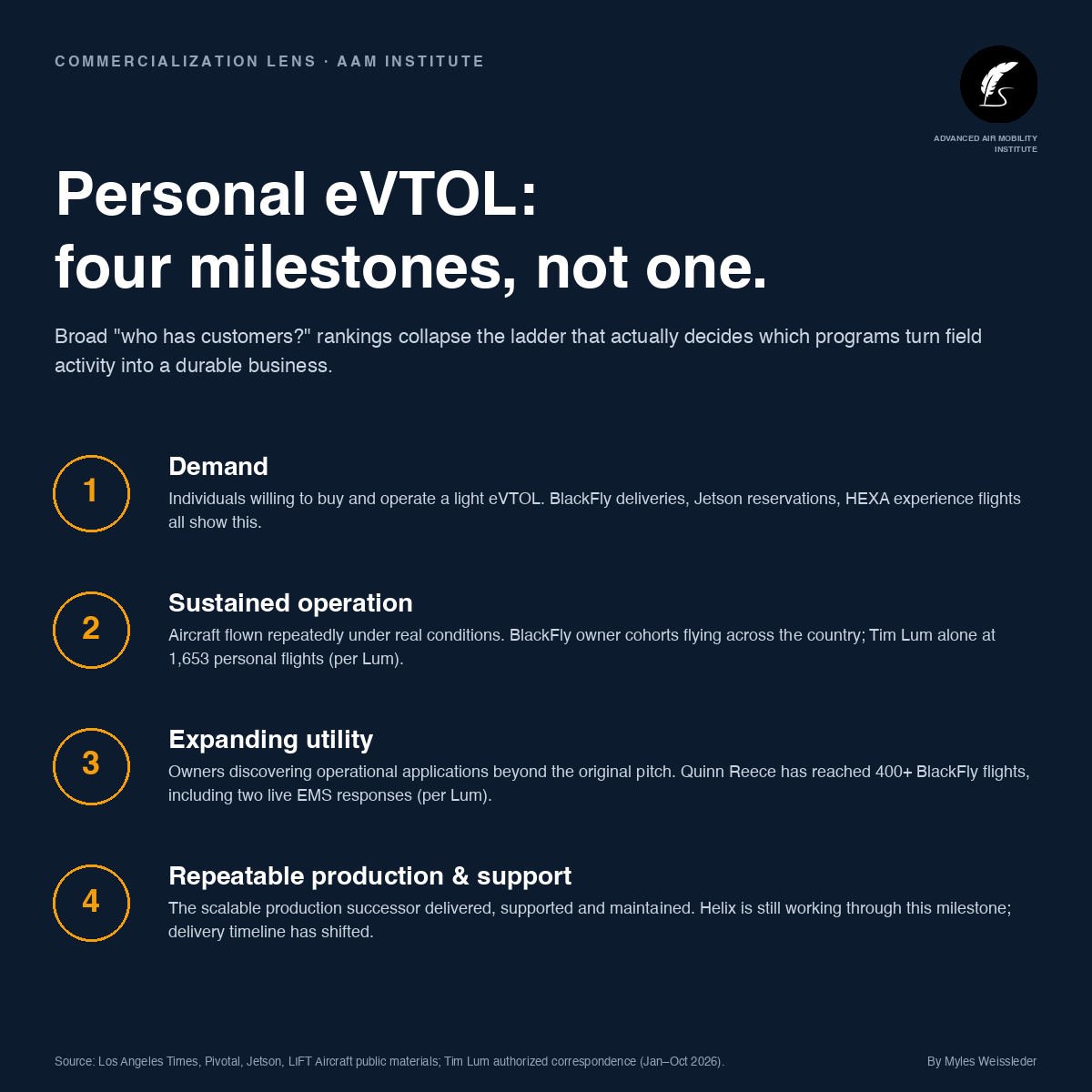
The more useful distinction is therefore not between companies that "have customers" and those that do not. It is between evidence of demand, evidence of sustained operation, evidence of expanding utility, and evidence of repeatable production and support.
BlackFly is unusually strong evidence across the middle of that progression. Thirteen aircraft were delivered. Individual owners have accumulated substantial operating histories. One pilot has surpassed 400 flights and, according to Lum, participated in two live EMS responses. Those examples do not establish a scaled EMS market, nor do they demonstrate a repeatable commercial model. They do show something commercially important: the aircraft has moved beyond manufacturer-controlled demonstrations into customer hands, where repeated use is beginning to reveal applications the market itself may value.
On October 17, 2026, that operating community will become unusually visible. Ten BlackFly pilots, including Tim Lum, Quinn Reece, Patrik Muzila, Aeddon Chipman, Brandon Goff, David Cook, Ron Ayson, James Robinson, Heather Chirtea and John Chirtea, will compete at the Great American Electric Aircraft Race at Springfield-Beckley Municipal Airport in Ohio, flying three privately owned BlackFly aircraft. The event is hosted by the National Advanced Air Mobility Center of Excellence (NAAMCE) in partnership with Dan Grande Sloat, JD/MBA FRAeS and the Advanced Air Mobility Institute.
The significance is not the event affiliation itself, but what will be operating there: customer-owned aircraft rather than manufacturer demonstration assets, flown publicly by trained pilots. Against a private BlackFly fleet John Chirtea estimates at approximately five aircraft, three owner aircraft appearing at one event represent a substantial share of the installed customer base.
Taken together, the flight histories, emerging operational uses and race participation illustrate a commercialization asset that is easy to overlook: an installed base can become part of the go-to-market engine. Experienced owners generate operating data, expose use cases, train additional pilots, demonstrate the product publicly and provide prospective customers with evidence that does not originate in a manufacturer's marketing department. For an unfamiliar category, that kind of customer-led proof can be particularly valuable.
That is different from a reservation list.
Jetson's sold-out production windows and reported deliveries speak primarily to demand and initial delivery. LIFT's experience and public-use programs represent another route to getting aircraft and people into repeated operation. BlackFly offers unusually visible evidence of what can happen after aircraft leave the manufacturer and develop an operating life of their own.
Helix faces the next test: translating that accumulated market and operating proof into repeatable production and support.
That distinction also makes broad eVTOL rankings less informative. A single-seat ultralight and a certificated passenger aircraft face different regulatory burdens, economics and commercialization clocks. Each can be ahead on one dimension and behind on another.
For personal eVTOL, the next meaningful milestone is not simply another order announcement. It is whether early demand, sustained customer operation and emerging utility can become a durable manufacturing, delivery and support system.