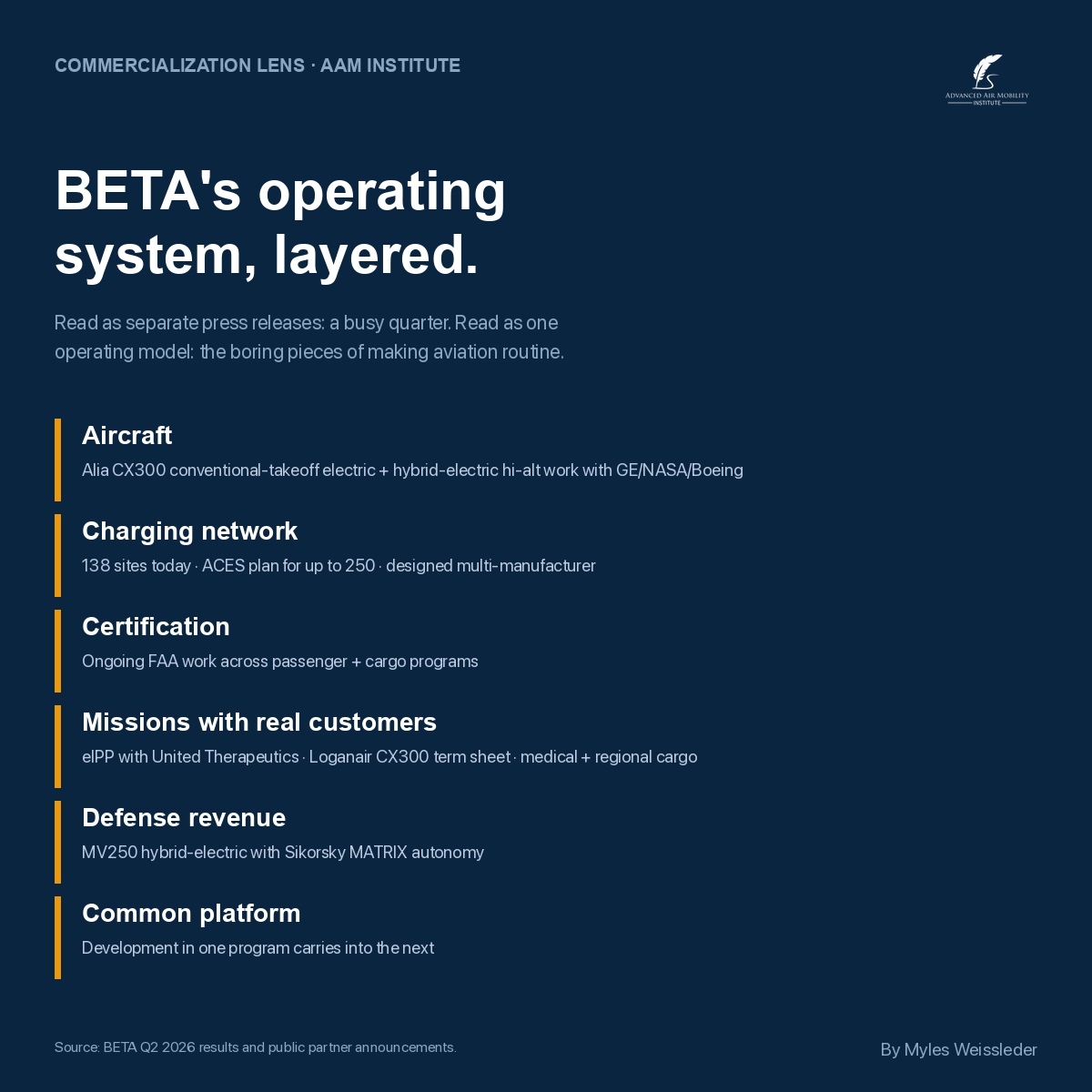
Advanced-air-mobility companies are usually compared by aircraft: range, payload, cruise speed, propulsion architecture, certification schedule. BETA Technologies becomes more interesting when the comparison shifts from aircraft to systems. Its second-quarter update included a set of developments that are individually notable and collectively more important: the first operations under the federal eVTOL Integration Pilot Program, a charging network that has grown to 138 sites, an ACES plan that could expand interoperable charging to as many as 250 locations, continued FAA certification work, a Loganair term sheet for five CX300 aircraft plus five options, high-altitude hybrid-electric work with GE Aerospace, NASA and Boeing, and the MV250 defense platform with Sikorsky MATRIX autonomy. Read as separate press releases, that looks like a busy quarter. Read as one operating model, it looks like something else: BETA is assembling many of the unglamorous pieces required for aviation to become routine.
An aviation business needs more than aircraft. It also needs places to charge, regulatory pathways, trained operators, maintenance capability, customers with real missions, dispatch experience, financing, supply chains and enough repeated operations to learn what breaks. BETA's strategy increasingly touches nearly all of those layers. The charging network matters because infrastructure often arrives too late in transportation transitions; BETA is putting hardware into airports before its own aircraft reach scaled commercial service and is designing the network to support more than one manufacturer. The eIPP work matters because operational learning is different from demonstration flying, and transporting manufactured organs for United Therapeutics ties the aircraft to a mission that already exists, a customer that already values time and an airport network that already understands aviation operations. The Loganair term sheet matters for a related reason: regional cargo and passenger operators do not need to invent a completely new consumer behavior if electric aircraft can fit missions they already fly. The defense work matters because certification timelines are long and capital is expensive, and defense programs can produce revenue, flight hours, autonomy learning and manufacturing experience while civilian programs continue to mature. Underneath all of it, the common-platform strategy allows development in one program to carry into another.
None of this makes BETA's path easy. A charging-site count does not tell us utilization, a term sheet is not the same thing as a delivered fleet, eIPP operations remain early, certification is still unfinished, and infrastructure revenue today is not proof of scaled aircraft economics tomorrow. But those are the right questions to be asking, and BETA is one of the few programs that can answer them in more than one dimension at once. The sector spent much of the last decade asking which aircraft looked most futuristic. The next decade will likely reward the companies that look most ordinary operationally, the ones that can dispatch repeatedly, maintain the aircraft, charge it, train the people, serve customers with missions today and generate enough operating data to improve the system tomorrow. BETA's answer, increasingly, is to build as many of those pieces as possible before commercial service arrives at scale. The least futuristic-looking company in AAM may turn out to be one of the most advanced commercially.