A useful contradiction is developing in advanced air mobility. The two best-known U.S. eVTOL companies continue to make technical, certification and strategic progress, yet their stocks have spent much of 2026 moving in the opposite direction. The aircraft have not stopped working; public markets are simply beginning to price a different set of questions.
That work is increasingly visible. Joby is deep in FAA certification, generates revenue through Blade, and in the second week of September became the first U.S. operator under the White House-backed eVTOL Integration Pilot Program, basing an S4 at Perot Field Fort Worth Alliance Airport for a five-day Dallas-Fort Worth campaign into DFW International's controlled airspace. Archer is expanding beyond Midnight through its pending Boeing transaction, which would add Wisk, Insitu and SkyGrid and bring an established defense business into the company.
The capital numbers make the shift concrete. Even as those Texas flights got underway, JOBY shares set a fresh 52-week low, closing near $6.25 on September 10 and well below the roughly $20 level reached in August 2025. Joby reported $372.1 million in R&D and $138.1 million in SG&A in the first six months of 2026. Archer's expansion carries a similar tension: Insitu brings more than $200 million in annual revenue and Boeing becomes a major strategic shareholder.
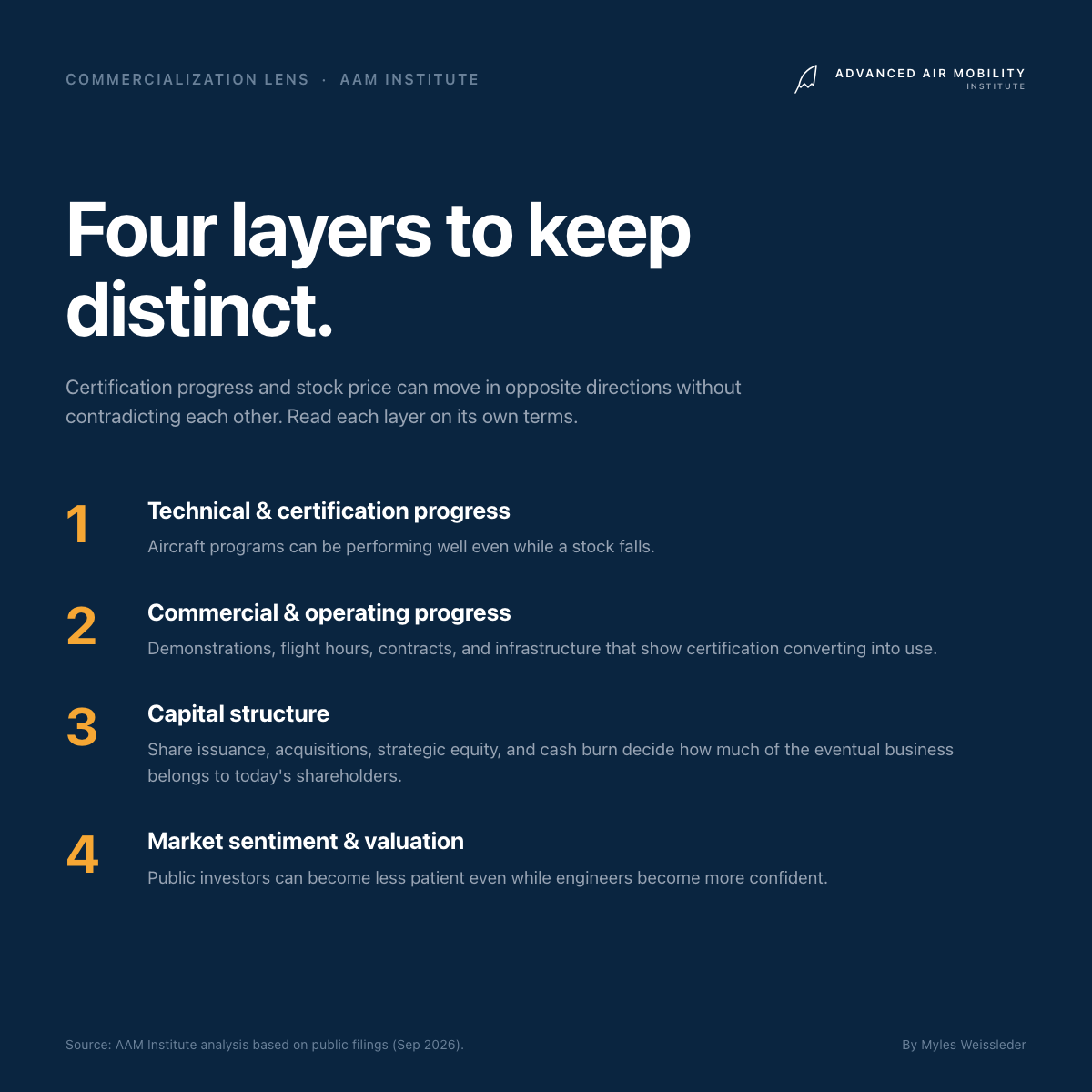
Four layers are worth keeping distinct. Technical and certification progress — an aircraft program can be performing well while a stock falls. Commercial and operating progress — flight hours, passenger operations and infrastructure show whether certification is starting to convert into use. Capital structure — share issuance, acquisitions and cash burn determine how much of the eventual business belongs to today's shareholders. Market sentiment — investors can become less patient even while engineers become more confident.
That divergence may be one of the more important dynamics in AAM over the next 24 months. Read charitably, it is maturation rather than distress: the market spent years rewarding evidence that advanced aircraft could exist and is increasingly asking for evidence that advanced aviation businesses can exist at scale. The companies best positioned for the next phase will be the ones whose commercial and capital stories can advance in parallel with the technical one.
Disclosure: The author previously worked at Joby Aviation. This analysis is based entirely on public filings and public company information and is not investment advice.